the sea
The sea in The Old Man and the Sea is not a passive backdrop but a living, feminine presence—la mar—that gives and withholds favors, a character as complex as any human. Santiago thinks of her as a woman who can be kind or cruel, and his relationship with her defines his identity, his labor, and his code of endurance. The sea is the arena of his struggle, the source of his brotherhood with the marlin, and the force that ultimately strips him of his prize, yet he never curses her; he accepts her nature as he accepts his own.
The Sea as Feminine and Living
Santiago always thought of the sea as la mar, the Spanish feminine form, and as something that gave or withheld great favors. If she did wild or wicked things, he believed, it was because she could not help them. The moon affects her as it does a woman, he thought. This gendering of the sea is deliberate and personal: the younger fishermen, those who used buoys as floats for their lines and had motorboats bought when shark livers had brought much money, spoke of her as el mar, masculine—a contestant, a place, or even an enemy. But Santiago’s sea is not an opponent to be conquered; she is a living entity with moods, seasons, and a will of her own. He loves her, and he loves the creatures that belong to her: the flying fish are his principal friends on the ocean, the porpoises are his brothers, and even the great marlin he kills is a brother. The sea is the medium of this kinship, the element that joins all living things in a cycle of feeding and being fed.
The Sea as Arena of Struggle and Code
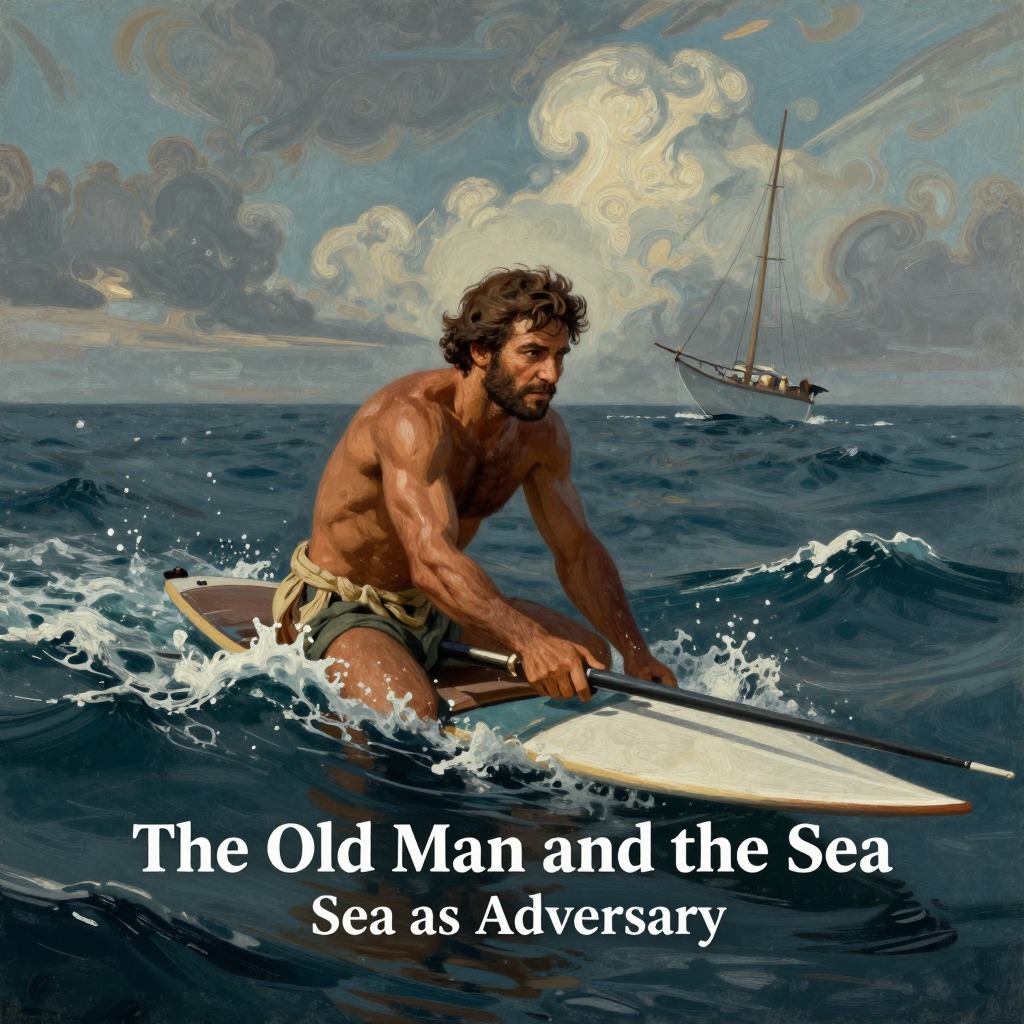
The sea is the stage on which Santiago proves his code. He rows out far beyond the other fishermen, leaving the smell of the land behind and entering the clean early morning smell of the ocean. He works the great well, a sudden deep of seven hundred fathoms where all sorts of fish congregate, and he keeps his lines with a precision that he believes is better than luck. When he hooks the marlin, the sea becomes the field of a three-day ordeal: the fish tows the skiff steadily toward the northwest, and Santiago holds the line across his back, enduring the pain of the cord cutting into his flesh. The sea is not an enemy in this struggle; it is the neutral medium that permits the contest. Santiago does not blame the sea for the sharks that come to devour his fish; he blames himself for going out too far. The sea is simply what it is—beautiful, cruel, and indifferent to human intention. When the Mako shark hits, Santiago knows that the shark is not an accident; it came up from deep down in the water as the dark cloud of blood had settled and dispersed in the mile-deep sea. The sea delivers both the fish and the sharks, and Santiago accepts this without complaint.
The Sea as Source of Sustenance and Destruction
The sea provides Santiago’s livelihood, but it also exacts a terrible price. He has gone eighty-four days without a fish, and the fishermen make fun of him; the sail of his skiff, patched with flour sacks, looks like the flag of permanent defeat. Yet the sea also gives him the marlin, the biggest fish he has ever seen or heard of, and for a moment he is triumphant. But the sea’s bounty is never secure: the sharks come, and by the time Santiago reaches the little harbour, the marlin is only a skeleton—a great long white spine with a huge tail at the end that lifts and swings with the tide. The sea has taken everything except the proof of the struggle. Santiago’s final judgment is not against the sea but against his own decision: “I went out too far.” He violated his luck, he thinks, when he went too far outside. The sea is not blamed; it is simply the element in which a man must live and die, and the only question is whether he lives according to his code.
The Sea as a Mirror of the Human Condition
The sea reflects Santiago’s inner life. When he is alone and suffering, he looks at the sea and sees the prisms in the deep dark water, the strange undulation of the calm, and the clouds building up for the trade wind. He sees a flight of wild ducks etching themselves against the sky over the water, then blurring, then etching again, and he knows that no man is ever alone on the sea. The sea is his companion, his adversary, and his teacher. He thinks of how some men fear being out of sight of land in a small boat, and he knows they are right in the months of sudden bad weather. But he also knows that the sea, in hurricane months when there are no hurricanes, offers the best weather of all the year. The sea is not a symbol of something else; it is the actual, physical reality that shapes Santiago’s life and death. He loves it, he respects it, and he accepts that it will ultimately destroy him. The sea is the great, indifferent, beautiful, and terrible force that makes a man of Santiago, and it is the force that, in the end, leaves him with nothing but the skeleton of his triumph and the dream of the lions on the beach.